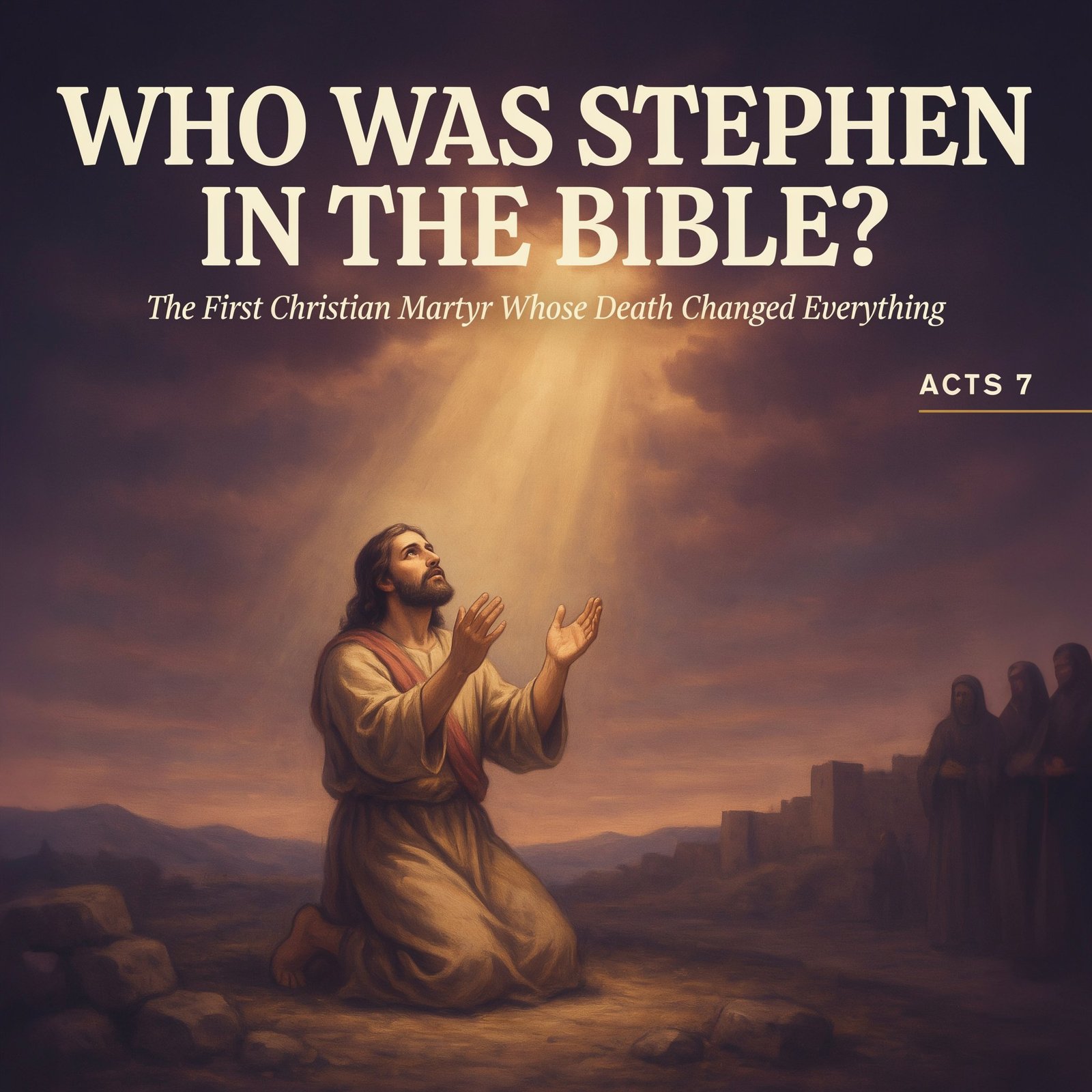
Who Was Stephen in the Bible? The First Christian Martyr Whose Death Changed Everything
so Among all the remarkable figures in the New Testament, Stephen holds a uniquely powerful position. He was not one of the original twelve apostles. Notably, he never walked with Jesus during His earthly ministry either. Yet his impact on early Christianity was so profound and so far-reaching that his story still inspires believers nearly two thousand years later.
Furthermore, Stephen holds two extraordinary distinctions in Christian history. He was the first person officially appointed as a deacon in the Church. Even more significantly, he became the first Christian martyr — the first follower of Jesus to die specifically for his faith. His execution by stoning in Jerusalem set in motion a remarkable chain of events that ultimately spread Christianity across the entire known world.
Moreover, Stephen’s story is not simply a tale of tragic death. In reality, it is a story of extraordinary faith, remarkable courage, divine wisdom, and Christ-like forgiveness that continues to challenge and inspire every generation of believers. This article explores who Stephen was, what he did, what he said, how he died, and precisely why his legacy remains one of the most important in all of Christian history.
Quick Fact Table
| Detail | Information |
| Full Name | Stephen (Greek: Stephanos = “Crown”) |
| Appears In | Acts 6–8, Acts 11:19, Acts 22:20 |
| Role | First Christian Deacon, First Christian Martyr |
| Appointed By | The Twelve Apostles |
| Known For | Miracles, bold preaching, death by stoning |
| Accusers | Members of Jerusalem synagogues |
| Tried Before | The Sanhedrin (Jewish High Council) |
| Method of Death | Stoning |
| Witness at Death | Saul of Tarsus (later Apostle Paul) |
| Feast Day | December 26 (Western), December 27 (Eastern) |
| Patron Saint of | Deacons, stonemasons, headache sufferers |
1. Stephen’s Background: Who Was He?
The Bible does not provide extensive biographical details about Stephen’s early life. However, several important clues within Acts reveal significant information about his background and character. His name — Stephanos in Greek — means “crown” or “wreath.” This detail suggests he came from a Greek-speaking Jewish background rather than a Palestinian Hebrew-speaking one.
A Hellenistic Jewish Believer
Stephen was almost certainly a Hellenistic Jew — someone who grew up outside Palestine in the Greek-speaking diaspora and adopted Greek language and culture alongside his Jewish faith. This background made him exceptionally well-suited for his role in the early Church. As a result, he could communicate effectively across both Jewish and Greek cultural contexts with equal confidence and clarity.
When Stephen first appears in Acts, he is already a committed believer in Jesus Christ. Acts 6:5 describes him specifically as “a man full of faith and of the Holy Spirit.” This description places him among the most spiritually distinguished figures in the entire early Christian community. Even the original apostles immediately recognized his exceptional spiritual quality and character.
A Man of Exceptional Character
Beyond his spiritual gifts, Stephen also possessed remarkable practical qualities that set him apart. He had wisdom, integrity, and a strong, well-established reputation among believers throughout Jerusalem. These qualities, combined with his deep and evident faith, made him a natural and obvious choice when the apostles needed trustworthy leaders to serve the rapidly growing Church.
2. Stephen’s Appointment as a Deacon
The circumstances leading to Stephen’s appointment appear clearly in Acts 6:1–6. As the early Christian community grew rapidly in Jerusalem, a serious practical problem emerged within it. Greek-speaking Jewish widows were being overlooked in the daily food distribution. Hebrew-speaking widows received proper and consistent care. The Hellenistic widows, however, faced ongoing neglect — whether through cultural bias, communication gaps, or simple administrative failure.
The First Church Organizational Crisis
This situation represented the first significant organizational crisis in the entire history of the Church. The twelve apostles recognized they could not personally manage both daily practical administration and their essential work of prayer and teaching simultaneously. Consequently, they gathered the whole community together and proposed a clear and workable solution to the growing problem.
Specifically, they instructed the community to select seven men of good reputation, full of the Holy Spirit and wisdom, who would take responsibility for practical community service. This arrangement would free the apostles to devote themselves fully to prayer and the ministry of God’s Word. The role these seven men filled eventually became what the Church formally calls the diaconate — from the Greek word diakonia, meaning service.
Stephen: First Among the Seven
The community selected seven men for this important role. Stephen’s name appears first on the list — a position of prominence suggesting the community considered him the most distinguished among the group. The other six were Philip, Prochorus, Nicanor, Timon, Parmenas, and Nicolaus. Subsequently, the apostles prayed and laid their hands on all seven men, formally commissioning them for their new ministry of service.
This moment of appointment carried deep historical significance for the Church. It established the principle of shared leadership and delegated responsibility as foundational to Christian community life. Additionally, it demonstrated that practical service and spiritual ministry were both essential and equally honored within the growing Christian movement.
3. Stephen’s Ministry: Signs, Wonders, and Bold Preaching
After his appointment, Stephen quickly demonstrated that his ministry extended far beyond practical administration. Acts 6:8 records that “Stephen, full of grace and power, was performing great wonders and signs among the people.” This description places him in the same category as the apostles themselves in terms of miraculous ministry — a remarkable elevation for a newly appointed deacon.
Miracles That Attracted Serious Attention
The miracles Stephen performed attracted both enthusiastic attention from believers and hostile scrutiny from religious opponents throughout Jerusalem. His public ministry was visible and powerful enough to provoke serious organized opposition. Acts 6:9 specifically mentions members of the Synagogue of the Freedmen — including people from Cyrene, Alexandria, Cilicia, and Asia — who began arguing with Stephen in public settings.
These were not casual or uninformed opponents. They were educated, theologically trained men who fully believed they could defeat Stephen in open intellectual debate. Nevertheless, Acts 6:10 records a striking and significant result — “They were unable to cope with the wisdom and the Spirit with which he was speaking.” Every argument they raised, Stephen answered with greater wisdom and clarity than they could match or counter.
Fabricated Accusations Against Stephen
Frustrated by their repeated and embarrassing failures in legitimate debate, his opponents turned to dishonest and dangerous tactics. They secretly persuaded men to fabricate serious accusations against Stephen. These false witnesses claimed to have heard him speak blasphemous words against both Moses and God. Additionally, they stirred up the people, elders, and scribes against him throughout the city. Eventually, authorities seized Stephen and brought him before the Sanhedrin — the supreme Jewish council in Jerusalem — to face formal trial.
At the trial itself, false witnesses testified that Stephen had claimed Jesus would destroy the temple and change the customs Moses handed down. These charges deliberately portrayed Stephen as a dangerous revolutionary threatening the very foundations of Jewish religious identity and national life.
4. Stephen’s Defense: The Most Powerful Speech in Acts
What followed Stephen’s arrest was one of the most remarkable speeches recorded anywhere in the New Testament. Acts 7 preserves his full defense before the Sanhedrin — a sweeping, brilliantly constructed address that covers Israel’s entire history from Abraham through Moses to Solomon and ultimately to Jesus Christ Himself.
A Masterclass in Biblical Theology
Stephen began his defense with Abraham and the covenant God made with him in Mesopotamia. He then moved carefully through the story of Joseph, the Egyptian captivity, and the dramatic call of Moses at the burning bush. Throughout this detailed historical survey, he made a consistent and deliberately provocative theological point — the Jewish people had repeatedly and consistently rejected the very leaders and messengers God sent to them throughout their history.
Specifically, Joseph’s brothers rejected him out of jealousy. The Israelites rejected Moses when he first tried to rescue them from oppression. In both cases, God ultimately vindicated the rejected leader and used him powerfully for His purposes. This pattern, Stephen argued, repeated itself with devastating consistency throughout Israel’s entire national story.
God Cannot Be Contained in a Building
Stephen then advanced his most pointed and theologically daring argument before the council. He contended that God had never been limited to or contained within any physical structure — including Solomon’s magnificent and beloved temple in Jerusalem. Quoting directly from the prophet Isaiah, he showed that God Himself declared no earthly house could truly contain Him. This argument struck precisely and deliberately at the temple-centered religious identity of the Sanhedrin members sitting in judgment before him.
The Climactic and Courageous Accusation
Having carefully laid this historical and theological foundation, Stephen delivered his climactic accusation directly to the council members themselves. He called them stiff-necked people who resisted the Holy Spirit just as their ancestors had always done throughout Israel’s history. He accused them specifically of betraying and murdering the Righteous One — Jesus Christ — just as their ancestors had killed the prophets who foretold His coming centuries earlier.
This was not a defensive speech designed to secure his personal release or survival. Instead, it was a bold, Spirit-filled proclamation of truth delivered with complete disregard for personal safety or consequences. Stephen understood exactly what he was saying and what the likely outcome would be. Truth, in his unwavering conviction, mattered far more than self-preservation.
5. The Vision of Heaven: Stephen Sees Jesus Standing
At the climax of his speech, something extraordinary happened that immediately transformed the entire atmosphere of the trial. Acts 7:55–56 records that Stephen, “being full of the Holy Spirit, gazed intently into heaven and saw the glory of God, and Jesus standing at the right hand of God.” He then announced this remarkable vision openly and directly to the assembled Sanhedrin.
The Deep Theological Significance
This vision carries profound and multilayered theological significance for Christian faith. Throughout the New Testament, Jesus typically appears described as seated at the right hand of God — a posture representing completed redemptive work and established royal authority. Here, uniquely and strikingly, Jesus is standing rather than seated. Many theologians across centuries of Church history interpret this as Jesus rising specifically to honor His faithful witness. In this reading, the Lord stood to personally welcome the first martyr who was about to give his life for the Gospel.
An Echo That Enraged the Council
This vision also directly and unmistakably echoed Jesus’s own words during His personal trial before the Sanhedrin. Jesus had told the council they would see the Son of Man sitting at the right hand of Power. For any council members who had been present at both trials, the parallel was impossibly clear and deeply infuriating. Rather than silencing the Christian message, their condemnation of Jesus had apparently produced exactly what He had promised them they would witness.
6. The Stoning of Stephen: Christianity’s First Martyrdom
The Sanhedrin’s response to Stephen’s heavenly vision was immediate, furious, and violent. Acts 7:57 records that they cried out loudly, covered their ears, and rushed upon him together as one body. They dragged him outside the city walls and began stoning him. The witnesses who had brought formal charges against him laid their outer garments at the feet of a young man named Saul, who watched approvingly.
Stephen’s Final Words Mirror Christ
As the stones struck his body, Stephen prayed two final prayers that deliberately and powerfully echoed the dying words of Jesus on the cross. First, he cried out, “Lord Jesus, receive my spirit” — directly mirroring Jesus’s prayer, “Father, into your hands I commit my spirit.” Then, falling to his knees, he called out loudly, “Lord, do not hold this sin against them!” This prayer directly paralleled Jesus’s intercession, “Father, forgive them, for they do not know what they are doing.”
The Extraordinary Depth of His Forgiveness
These final words reveal the extraordinary spiritual maturity and Christ-like character of Stephen in his most extreme moment of suffering. Even as stones struck him repeatedly, his final concern was entirely for the forgiveness of those killing him rather than for his own survival or vindication. Acts 7:60 records that he then “fell asleep” — a phrase that beautifully reflects the early Christian understanding of death as a temporary sleep before glorious resurrection.
Saul Watches: A Seed of Future Transformation
The specific detail about Saul standing, watching, and approving Stephen’s death is among the most historically significant in the entire New Testament narrative. Saul of Tarsus later became the Apostle Paul — arguably the most important and influential missionary in all of Christian history. Church Fathers, including the great Augustine of Hippo, specifically suggested that witnessing Stephen’s peaceful, forgiving death planted a powerful seed deep within Saul’s conscience. That seed, in their view, eventually contributed directly to his dramatic and life-changing encounter with the risen Christ on the road to Damascus.
7. The Impact of Stephen’s Death on Early Christianity
Stephen’s martyrdom produced immediate and far-reaching consequences for the early Church throughout Jerusalem and beyond. Acts 8:1 records that on the very day of Stephen’s death, a great persecution broke out against the entire Church in Jerusalem. Saul himself became a leading and zealous force in this persecution, going from house to house and dragging believers off to prison throughout the city.
Persecution Paradoxically Spreads the Gospel
This intense persecution, however, produced a deeply unintended consequence that ultimately transformed world history in ways its architects never anticipated. Acts 8:4 records that the scattered believers “went about preaching the word” wherever they traveled. The very persecution specifically designed to extinguish Christianity instead scattered believers like seeds across Judea, Samaria, and far beyond. In doing so, it fulfilled precisely Jesus’s command to be His witnesses “to the ends of the earth.”
Philip and the Expanding Mission
Philip — another of the original seven deacons — traveled to Samaria and preached there with extraordinary power and remarkable success. Thousands responded to the Gospel message in a region traditionally hostile to Jewish religious outreach. Additionally, Acts 11:19 specifically and explicitly links the broader missionary expansion of the early Church to the persecution that began directly with Stephen’s death.
A Paradox That Defines Church History
In a profound and deeply paradoxical sense, therefore, Stephen’s martyrdom was the specific catalyst that transformed a Jerusalem-based Jewish movement into a genuinely world religion. The enemies of the Gospel, by killing its first martyr, accidentally became the instruments through which it reached the entire world. This extraordinary irony has not been lost on Christian theologians and historians across all the centuries since.
8. Stephen’s Legacy in Church History and Theology
Stephen’s influence on Christian theology and Church history extends far beyond the immediate narrative recorded in Acts. His speech before the Sanhedrin represents one of the earliest and most sophisticated examples of Christian biblical theology ever recorded. Through it, he demonstrated with clarity and power how the entire Old Testament story finds its ultimate fulfillment and deepest meaning in Jesus Christ.
The Enduring Model of Christian Martyrdom
Stephen established the definitive template for Christian martyrdom that has sustained believers through centuries of fierce persecution across every continent. His specific combination of bold proclamation, miraculous signs, Spirit-filled wisdom, and Christ-like forgiveness in death became the model the Church has returned to repeatedly throughout its entire history. Countless subsequent martyrs throughout the centuries have deliberately looked to Stephen’s example as their inspiration and their guide.
The Feast Day and Its Meaning
The Church celebrates Stephen’s feast day on December 26 — the day immediately following Christmas. This deliberate placement carries deep and intentional theological significance. By positioning the first martyr’s celebration directly after the celebration of Christ’s birth, the Church draws a direct and powerful connection between the incarnation of Jesus and the willingness to die for Him. Even the famous Christmas carol “Good King Wenceslas,” set on this feast day, gives Stephen’s memory a lasting place within popular Christian culture worldwide.
His Name Lives Across Centuries
Across nearly two millennia of Christian history, the name Stephen has remained one of the most widely used Christian names throughout the world. Parents across every culture and tradition have named children after him as a personal declaration of faith, courage, and commitment. Countless churches, schools, hospitals, and charitable organizations bear his name globally — tangible evidence of an enduring legacy that death could not diminish and time has not erased.
If you enjoyed reading this, discover more celebrity insights :Donald Loving: The Child Who Changed America’s Civil Rights History Foreve
FAQs
Q1. Why is Stephen considered the first Christian martyr?
Stephen holds this historic distinction because he was the first recorded follower of Jesus Christ specifically killed for his faith after the resurrection and ascension of Jesus. His death by stoning in Acts 7 established him as the founding example of Christian martyrdom. Every subsequent Christian martyr throughout history has looked back to Stephen as the defining and inspiring model of faithful witness unto death.
Q2. What was Stephen’s role in the early Church before his death?
Stephen served as one of the first seven deacons appointed by the apostles in Acts 6. His specific responsibility was overseeing the fair distribution of food to Greek-speaking Jewish widows in the Jerusalem community. Beyond this practical service, he also performed miracles and engaged in powerful public preaching — demonstrating powerfully that practical service and spiritual ministry are inseparable in genuine Christian life.
Q3. What did Stephen see just before he died?
Just before his death, Stephen received an extraordinary and unique vision of heaven itself. Acts 7:55–56 records that he saw the glory of God and Jesus standing at God’s right hand. He announced this remarkable vision openly and directly to the Sanhedrin — a declaration that immediately further enraged his accusers and directly preceded the violent stoning that ended his earthly life.
Q4. What connection does Stephen have to the Apostle Paul?
The Apostle Paul — then known as Saul of Tarsus — stood present at Stephen’s stoning and actively approved his execution. Acts 7:58 specifically records that the witnesses laid their garments at Saul’s feet. Church Fathers including Augustine of Hippo believed that witnessing Stephen’s peaceful, forgiving death planted a powerful seed in Saul’s conscience — a seed that eventually contributed directly to his dramatic conversion to Christianity on the road to Damascus.
Q5. What lessons can modern Christians learn from Stephen’s life?
Stephen’s life teaches several powerful and timeless lessons for believers today. Faithful service in practical ministry and bold spiritual witness are both essential and equally valuable components of Christian life. The Holy Spirit provides wisdom and courage that surpasses human understanding when believers face serious opposition. Above all, genuine Christ-like love — demonstrated most powerfully in Stephen’s dying prayer of forgiveness for his killers — remains the most compelling and lasting testimony any believer can ever offer to a watching world.
Conclusion
Stephen’s story is ultimately about what authentic, Spirit-filled faith looks like when tested to its absolute and most extreme limit. He served faithfully in practical ministry without complaint or recognition. He preached boldly when others remained carefully silent. AlHe faced his accusers with Spirit-given wisdom, remarkable personal courage, and total reliance on God. Most powerfully of all, he forgave his killers with his dying breath — demonstrating a Christ-like love that left a permanent mark on the conscience of the man who would become Christianity’s greatest missionary.
Furthermore, Stephen’s death accomplished far more than his opponents ever intended or imagined. Rather than silencing the Gospel, his martyrdom scattered it powerfully across the world. Rather than destroying the early Church, the persecution his death triggered ultimately strengthened and expanded it beyond anything the apostles might have achieved had they remained safely in Jerusalem indefinitely.
Today, Stephen speaks powerfully and urgently to every believer who faces opposition, fear, or the temptation to compromise their faith for personal comfort and safety. His life and death declare with unmistakable clarity that truth is worth speaking, faith is worth keeping, and love — even for those who hate and harm us — is worth extending to the very last breath of life.
He was the first to wear the martyr’s crown. His name, Stephanos, means precisely that. In his death, he wore it gloriously, faithfully, and for all eternity.